Friday, April 21, 2017

Photographs: Finding the Truth Hidden in My Past


Sontag states that “one never understands anything from a photograph,” which is partially true in that it is impossible to capture two sides of an argument. For instance, nature photos always show two extremes: the biodiversity and unique lifeforms that inhabit Earth and the effects of human activities on the environment. There is never a balance between beauty and destruction, compassion and cruelty, etc. However, photographs—especially a collection of photos—hold the power to reveal the changes in a person throughout time. Writing may be able to provide a similar truth, but it is often to verbose to directly get to the point and cover a vast expanse of time.

Although I am too embarrassed to upload my baby photo, it shows me next to a karaoke machine surrounded by stuffed animals. According to my parents, I loved to sing. Yes, I know it contrasts completely from my current disposition, but this photo simply demonstrates the vast changes society has had on me. Before, I was a vivacious toddler, not caring about what other people said. Now, that ability of spontaneity is completely gone. I mean the fact that I am too afraid to post my baby photo simply shows how much I changed. I do not know exactly when, but I decided to become serious to live up to expectations that I placed on myself. The stuffed animals are replaced with AP review books and the karaoke machine is nowhere in sight. For the sake of being taken seriously, I have succumbed a great deal to societal pressures—that the lifestyle and personality of a toddler is too frivolous.

The photo was taken from my old house in Raleigh, North Carolina. That home represented the freedom of expression and exploration. I fell in love with nature because I was able to go into the big forest behind my backyard—which has now been almost completely cut down. I was able to connect with the land and to my surroundings. Now, my home in Troy, Michigan represents a change: the need to find something socially acceptable. There is no more forest to foster intellectual growth; I am supplied with artificial textbooks to learn. Even the extreme weather has trapped me in this home. In a way, I still find myself disconnected with this place.

Looking back at my photos brings nostalgia, evoking a stronger emotion than what simply reading writing can supply. But above all, photos hold a unique power to show change and allow for self-reflection. The image of that karaoke machine floods my brain with so many memories that words are incapable of doing; I would never be able to admit my still strong attachment with North Carolina without the sight of a past that I still cherish deep insight my heart. 

Saturday, March 18, 2017

Another Day, Another Microaggression


It was a normal Saturday: horrible weather combined with the typical stress versus relaxation warfare occurring in my brain. My life was finally turning for the better because all the stress from March was almost gone, and I survived an eight-day power outage (although this accomplishment would seem a little pretentious to people living in developing nations who lack electricity, clean drinking water, and other common luxuries I take advantage of). Today was the day to celebrate my birthday, which was actually on March 12th but I had too much going on that weekend.

Fast forward to going inside the restaurant, and my family and I are about to face an experience already commonplace for us. As we opened the door, the waitress’s face immediately changed from one that was warm and friendly to one that was cold. We stood there for a few seconds before she decided to acknowledge our presence and ask grumpily, “how many?” We replied accordingly to which she simply rolled her eyes and grabbed the menus. She eventually led us to this booth that was extremely gross—not only was it very dimly lit, but it also had visible crumbs all over it. We immediately asked if we could go to another booth, preferably one by the windows. This infuriated the waitress who spoke into her microphone to another waitress saying loudly, “they want to sit at a table near a window… do we even have any available?” Eventually she led us to a new table and left the three menus there and quickly left.

At first I did not think much about it. What if the waitress was just having a bad day? We all have those days where we do not feel like doing anything. However, this was not the case. My mom was the first to notice. When greeting a white family, she obliged to their every request. She did not even offer the horrible table to them. When we paid the bill and left, an African-American family was just getting seated in which they were offered the deplorable table that we were offered before. It is as if they reserved that set area just to torment anyone of a different race.

This microaggression we faced is only one of many we have faced in our lives. As Dr. Sue said, “microaggressions for people of color are constant, continual, and cumulative. They occur to people of color from the moment of birth to when they die.” The ones that have occurred to me the most are: where are you actually from? Where are you from from? So if you’re Asian, you’re supposed to be good at math right? Why can’t you solve this math problem, you’re Asian? However, there is some sense of hope. These microaggressions are definitely less frequent today than when my parents first came to America. It is a continuous process to change people’s perception to solve these racial issues.

Saturday, March 11, 2017

The Ultimate Paradox


Sorry for being political again, but the essence of Environmental Science is its interdisciplinary nature. You cannot just focus on the science; you have to encompass social, economic, political, scientific, etc. aspects. According to Trump’s new Office of Management and Budget proposal, the government plans to cut the Environmental Protection Agency’s budget by more than 25%. Although this could lead to an increase in economic growth, but in the long term, no growth can occur without a sustainable environment. It is the ultimate paradox. The public is blindly focusing on the economic success and not enough on the environment—the ultimate basis of all organisms living on Earth.

“The concept of global warming was created by and for the Chinese in order to make U.S. manufacturing non-competitive”

This type of mentality only serves to belittle years of scientific evidence of global warming. Environmentalists’ “beliefs are opinions only” (Williams 936). Although Trump is right in that Chinese has higher emission levels, he fails to notice the extended efforts to decrease emissions. In reality, China is leading in alternative energy to provide sustainable energy without environmental damage. The Three Gorges Dam, for example, generates massive quantities of hydroelectric power. However, more research needs to be done because the original construction of the dam displaced many people and killed many animals, decreasing biodiversity.


Three Gorges Dam in China

The world needs to lose its obsession of looking solely in the short term. Sure “financial loss is a serious matter,” but a destroyed environmental will lead to the inevitable “financial loss” (Williams 936). Plus, everyone at Troy High School should take AP Environmental Science with Mr. Zynda because its an amazing class!

Saturday, March 4, 2017

There Is No Unmarked Person


The Black Swan: a psychological thriller-horror film in which Natalie Portman transforms into the innocent, professional ballerina Nina. Throughout the movie, Nina goes through a metamorphosis from fragile to “damaged” to achieve the perfection—the black swan—that she desires so much, leading to her imminent death. On both sides, the white and black swan, Nina becomes marked.

The white swan represents the innocence and perfection that Nina already holds. Up until now, she has never experienced the “adult” things—lust, lying, and addiction—that are supposed to bring out the opposite nature that she holds. The pink room and her name serve to trap her into the grip of her scrupulous mother, bent on coddling her through adulthood while also restraining her from growing up because of her jealousy of seeing Nina become the professional ballerina that she never was. Thomas, the director, constantly criticizes her need to follow everything exactly and never letting go. As with all children, Nina is marked by her innocence; she is seen as babyish and neurotic. This torment forces all children to grow up and transform into a damaged version of themselves to achieve the carefree, effortless, and imprecise personality.

The black swan represents the greed, thievery, resentment, blame, and vengeance that comes with growing up and facing the evils of reality. Nina subjects herself to having sex, lying to her mother, and taking ecstasy to succumb to the black swan that she desperately wishes to become. It is in the final scene where Nina allows her inner darkness to shine by stabbing Lily, the backup dancer that has already achieved the black swan. However, in reality, Nina only stabbed herself which metaphorically allowed her to shed the outer perfection and engulf herself with evil. Despite achieving this status, Nina has inadvertently marked herself. Beth, the dying swan who was replaced by Nina for the role of the swan queen, represents the tarnished nature of growing up. Even though Beth has subjected herself to the horrors of the world, she is rejected by Thomas because of her old age and corruption. Becoming the black swan means marking oneself as dirty and corrupted—addicted to sex, drugs, and loose morals.

Similarly, children who subject themselves to this cycle of abuse are marked by society as deplorable; they become rejected by everyone, which leads to internal torment. Even without growing up to the extreme parts of society, children mark themselves in that they should be more responsible and a role model for other younger children. This unachievable balance between the white and black swan leads people, especially Nina, to internal torment and self-harm. The innocence that society values yet despises and the corruption and growth that society values yet despises creates no alternatives: “there is no unmarked [person]” (Tannen 556).

*Ms. Valentino: we should watch The Black Swan after the AP because there are so many symbols, motifs, and deeper meanings within the movie that we can discuss!

Friday, February 24, 2017

Unequal Gender Ratio


California Institute of Technology: a Garden of Eden for innovation in science and engineering. They have an amazing alumni network with 34 Nobel Prize winners and 71 winners of the US National Medal of Science or Technology. Not to mention, it is frequently mentioned in the media: Leonard and Sheldon from The Big Bang Theory are physicists at Caltech and Ocean’s eleven stole an electromagnetic pulse generator from the institute. However, the campus is the epitome of a gendered space—41% of undergraduates and only 29% of graduate students are women. Compared to Oberlin College that was coed since 1833, Caltech only decided to admit women since 1970!

What accounts for this disparity? From birth girls are given dolls and mini kitchens and guys are given blocks—toys that require more logic and engenders a passion for engineering. Naturally, women are not pushed to pursue careers in engineering (math, physics, etc.); it becomes this self-fulfilling prophecy: girls are told that they are bad at math and that they are more creative, leading to more “normal” professions such as fashion designers, writers, models. I still remember when I was little how my Dad told me to watch him do an oil change to gain practical skills in the future. However, both my sisters—although they were not interested in the first place—were not forced to observe. These experiences, universal to all cultures, breed a society that scoffs at women who try to pursue careers outside of the norm.

After years of being pushed towards other pursuits, girls pursue other passions, and Caltech finds itself with an extremely skewed gender ratio. But it is not just a matter of the statistics. I know two senior girls who have visited and applied to these schools who have felt that the community is very divided. Simply being a girl is an anomaly, which hinders women from realizing their full potential. Of course, the school has initiatives to help lessen the disparities, but these glaring differences still persist on campus. Caltech becomes a Mecca for aspiring male engineers with a few female students who have the courage to break all social standards; it presents itself as an obstacle rather than an accepting community for women. To truly get rid of the gendered standard requires an ideological shift and removal of all disparities of opportunities from boys and girls. 

Sunday, February 19, 2017

Irony for Thought

*This is not my extra credit blog post. Please scroll down to read my weekly blog post!*

It is currently Monday, 12:27 AM. I randomly thought about this and felt that I needed to pose this question to you guys. Chick-Fil-A's slogan is "Eat Mor Chikin." I guess the cows felt like they were victimized and deserved to live instead of the chickens. However, whenever I go to Chick-Fil-A, I decide to order their Cookies and Cream Milkshake, which by the way is absolutely amazing. What makes it more civil to inject the cows with hormones to produce unnatural amounts of milk to then be hooked up to a machine to milk their utters for the rest of their life than to simply end their life. Are the Chick-Fil-A cows on the advertisements aware of this injustice? If they are trying to "boycott" the use of cow meat, why are they not boycotting all cow products?

Eat Mor Irony

Saturday, February 18, 2017

A Modest College Proposal

It is a melancholy object to those who walk through this great school or travel in Troy, when they see the hallways, the classrooms, and group chats, crowded with college hopefuls of the adolescent age, followed by their 20-pound backpacks, all with a face of physical exhaustion and stress. These students instead of being able to easily get into their dream college, are forced to employ all their time in stressing about news reports of record breaking application pools and decreasing admission rates.

I think it is agreed by all parties that this prodigious number of students in schizophrenia is in the present deplorable state of the Troy School District; and, therefore, whoever could find out a more efficient method to guarantee college admissions would deserve so well of the Troy community as to have his or her statue set up for a preserver of the students’ mental and physical life.

I shall now therefore humbly propose my own thoughts, which I hope will not be liable to the least objection.

I have been assured by very knowledgeable students from HYPSM, that College Confidential is the source of guidance for aspiring high school students. It is filled with the most accurate, inspiring, invaluable, and candid advice; and I make no doubt that it will equally serve well for babies, middle and high school students.

I do therefore humbly offer it to public consideration that of the 2,000 students at Troy High, ~99% face extensive levels of stress to get into the college of their dreams; however, only a fraction will achieve their goals. With the use of College Confidential’s advice, Troy High could maximize the number of students reaching the perfect college with extensive scholarship money to pay for the outrageous prices to attend a university. The current average student debt after graduating an undergraduate institution is $30,100. With the extensive guidance from the website, that number can surely be reduced to zero by receiving scholarships and grant money.

As prescribed by many students from the College Confidential website, to get into HYPSM or any top college a student must do the following:
  1. Get perfect SAT or ACT scores
  2. Be rank #1 by having a 4.0 unweighted GPA and the highest possible weighted GPA (near 5.0 if possible)
  3. Take 20+ AP classes
  4. Do as many clubs as possible and get leadership positions
  5. Become internationally famous by winning prestigious competitions
  6. Become a nationally or internationally ranked athlete or musician
Most importantly, College Confidential states the following:
  1. Do not waste time sleeping, eating, drinking or relaxing
  2. Become a robot with no real passion and emotions
  3. Be superficial in nature
  4. Believe that getting into college is the most important task in life

Advice like this will guarantee any student admission to their top college desires and reduce their stress levels significantly. Many other advantages might be enumerated. For example, the success of all students will increase school recognition; which will directly lead to increase in federal funding to improve the quality of the school. No longer will there be budget cuts that force teachers to spend money out of their pocketbook instead of helping sustain their own lives; the ~10-year-old textbooks will be replaced with the newest ones on the market to guarantee student success; and most importantly, students will be given more opportunities to allow them to realize their full potential.

I profess, in the sincerity of my heart, that I have not the least personal interest in endeavoring to promote this necessary use of College Confidential, having no other motive than the students’ good of my city, by advancing Troy High, relieving the financial strain on teachers, and providing for adolescents. I am already far too old by which I can benefit from the website.

*HYPSM = Harvard, Yale, Princeton, Stanford, MIT (College Confidential terminology) 

--

I decided to post this because someone asked me on Thursday, “how’s your road to HYPSM going?” I was immediately taken aback—as if my existence depended only on my academic success to get to a top college. In all seriousness’s sake, do not go near College Confidential. The part about knowledgeable students is completely made-up; they in fact state the opposite: never go on that website. It is filled with wrong advice and is too focused on simply getting into college. You will become so obsessed with reading peoples’ perfect resume—which does not mean anything in the long run. Pave your own path and remember that it is just high school (HAVE FUN)! Your self-worth and chance for success in the real world is not dependent on what college you can go to. 

However, Chick-Fil-A is actually good for you compared to College Confidential


Saturday, February 11, 2017

Consider Death


I doubt this is normal but sometimes I cannot sleep at night because I think about death. Last year I remember trying to fall asleep but not possessing the ability to do so. The only way I find myself to avoid thinking about it is by taking a ton of AP classes. My mind will be so focused on my school work that I do not have time to wonder what death is and what it means. Sometimes during the summer I would just randomly wake up and think about it. Clearly, death presents itself in an elusive manner: it is so commonplace yet so mysterious. Medically speaking, death does not even have a clear definition. Does living off machines—becoming a vegetable—count as death? When the skin and blood are still warm but all circulatory and respiratory functions cease does that count as death? Or is it only when the entire brain, including the brain stem, no longer functions does it count as death?

Forget the medical jargon, death means a loss of our consciousness, memories—all characteristics that make us who we are. I am always left to wonder what it feels like to be dead. If we really lose consciousness, then what happens? Not to mention, in a couple hundred years no one will even remember us. Our existence will simply be recorded by the US government along with everyone else’s death. This inevitable fate is so close but so far away. We delude ourselves into not thinking about it, but death will inevitably creep up on us. Despite the belief that medicine will become advanced to provide immortality, if you simply think about it logically it cannot happen. The world is already filled with billions of people. Death is the only natural phenomena that keeps population in check. The US government is already facing huge issues to provide for the elderly. What makes you think that they want to keep a population that, economically speaking, has no value (unless you are some genius). Alas, death will come—be it tomorrow, next year, or 80 years later.

Humans take refuge in ignorance which allows us to waste their days on Earth. Rather than reaching some existential existence, we fashion ourselves a veil of obliviousness. Instead of valuing a simple drink of water, we take it for granted. Instead of cherishing our time with each other, we find ourselves trying to push people away. For instance, if you were to walk around Troy High and ask people about their parents, they would probably talk about how restrictive they are. Then, ask returning graduates who are at college about their parents. They will tell you about how much they value their parents. People need to wake up already! Death will come. We will all die one day. However, this should not stop us from considering all aspects of life. Away with the obsession with “lobster rolls, lobster turnovers, lobster…” and in with our morality and consciousness (Wallace 655).

These questions will stir-up a lot of debate. Some of you may even think I am crazy. However, this does not stop the power of death. I cannot concede to having found my existential existence. If I were to die today, I would pity myself in that I have wasted 16 years of my life doing nothing. However, for many people this may be wasting 50-60 years of their life. Our society has this firm belief that we will all reach the life expectancy of 80 years—this is not the case for many people. If you died now, would you be proud of what you accomplished? Instead of waiting many years later to do something practical and worthwhile with our lives, we need to start now. Once we reach our imminent death, we will not have to worry about a possible afterlife. 

Saturday, February 4, 2017

The Strongest Form of Love

*I based this post off Arm Wrestling with My Father*

Our interactions were rudimentary. The truth is, my parents have never said they loved me or kissed me goodnight because these actions are not in their nature. Never. I think the closest they have ever come to saying something like that was when my physician had to go through a series of questions about my mental health. He asked my parents about me and I guess it led to some forced statement about how they were proud of me—that they cared for me. Our communication was and still is very minimal—even more so with my Dad than my Mom. But with the few interactions I have per day I could feel how hard it was for them to communicate, to help me, to show the love they had for me, the love that I know is there.

My parents are atypical. They are not the expected “Asian parents” who berate me to achieve high academic success. They never check my report cards. When I ask them why they tell me that they already know that I aim for As. They never forced me to go to Chinese school, to take piano lessons, violin lessons, math courses, etc. In elementary school, they only went to one of my orchestra performances and one of my band performances in middle school (I went from orchestra to band to realizing I had no interest in music—making it my own decision to quit completely). They never forced me to take the number of AP classes I am taking. They never understood my neuroticism—my need to achieve the highest on ever exam, test, quiz, assignment I do. Furthermore, compared to “typical” parents in general, they are the complete opposite. They never attend any competitions I have. They are not the eager parents signing up to volunteer. To many it may seem cold; but to me, I know it is how they are.

Every day when I come home from school, Mom always greets me warmly and offers fresh fruit. Something so fundamental—food—but not guaranteed. Mom always tells me about living during the era after the Great Famine. Mom would vividly describe how so many people died and how people were forced to eat dirt and bark from trees to subsist the pangs of hunger. Exotic fruits—mangos, kiwi, things we take for granted—were unheard of during her time. Her notion of love was providing me the variety of foods she never had. Furthermore, she shows her love through her unwavering bravery. One time we were at a hotel swimming pool where they had lap lanes. Naturally people would be kind and adjust to circle swimming to accommodate more people. However, when we entered the lanes, an old white man in his fifties began screaming at us. I strictly remember him saying: DO YOU EVEN SPEAK ENGLISH? I wanted to leave immediately, but my mom forced us to stand our ground. She did not want to concede to racism. Eventually the man left, and my mom stood victorious. Mom’s strong willed character and compassion are her forms of love. I would not give this up for another parent to simply say “I love you.”


During the late 1960s and early 1970s, Mao Zedong declared that one “privileged” youth per urban family had to be sent to farming villages to become a worker/farmer. My Dad decided to go—in effect, he was forfeiting his chances of ever going to a university. However, Dad has—and will always have—a strong conviction to achieve against all odds. Even though he did not receive a formal education, he taught himself. He became an autodidact. Instead of receiving formal preparation for the Gaokao—the National Chinese Entrance Exam that is administered only once per year and decides your future—Dad had to learn everything on his own. This spanned from Karl Marx’s communist principles to chemistry and physics. He knew that if he failed the exam, he would be stuck as a farmer for the rest of his life. When the results came back, he had nearly scored a perfect in math and sciences. His lowest score was in the communist principles—I think—and he did not even have a textbook to study for that part. He  even scored considerably higher than his brothers and sisters who stayed in the city and received an education. Dad’s desire to succeed led him to receive his Ph.D., a feat that shocked his family. Today, he occasionally asks if I need help. He was always there to answer any questions I had on my calculus homework. His hard work to provide a steady income represents his love for me. It is with the money that he earns that he can give me the strongest power humans can possess: an education. His assurance he gives me that he will be able to pay for my education, no matter how far I reach, will always be there is the epitome of love. I do not need someone to attend my competitions. I do not need someone who simply tells me “I love you.” I need my Dad because he is willing to sacrifice everything to give me the opportunities I have today.


As every day goes on, I want to tell my parents I love them. I want to tell them how happy I am. Or maybe, rather than any of this, I will find a unique way to express my love to them.

Friday, January 27, 2017

A Hidden Secret

Multiple Sclerosis: a disease in which the immune system eats away at the protective covering of nerves

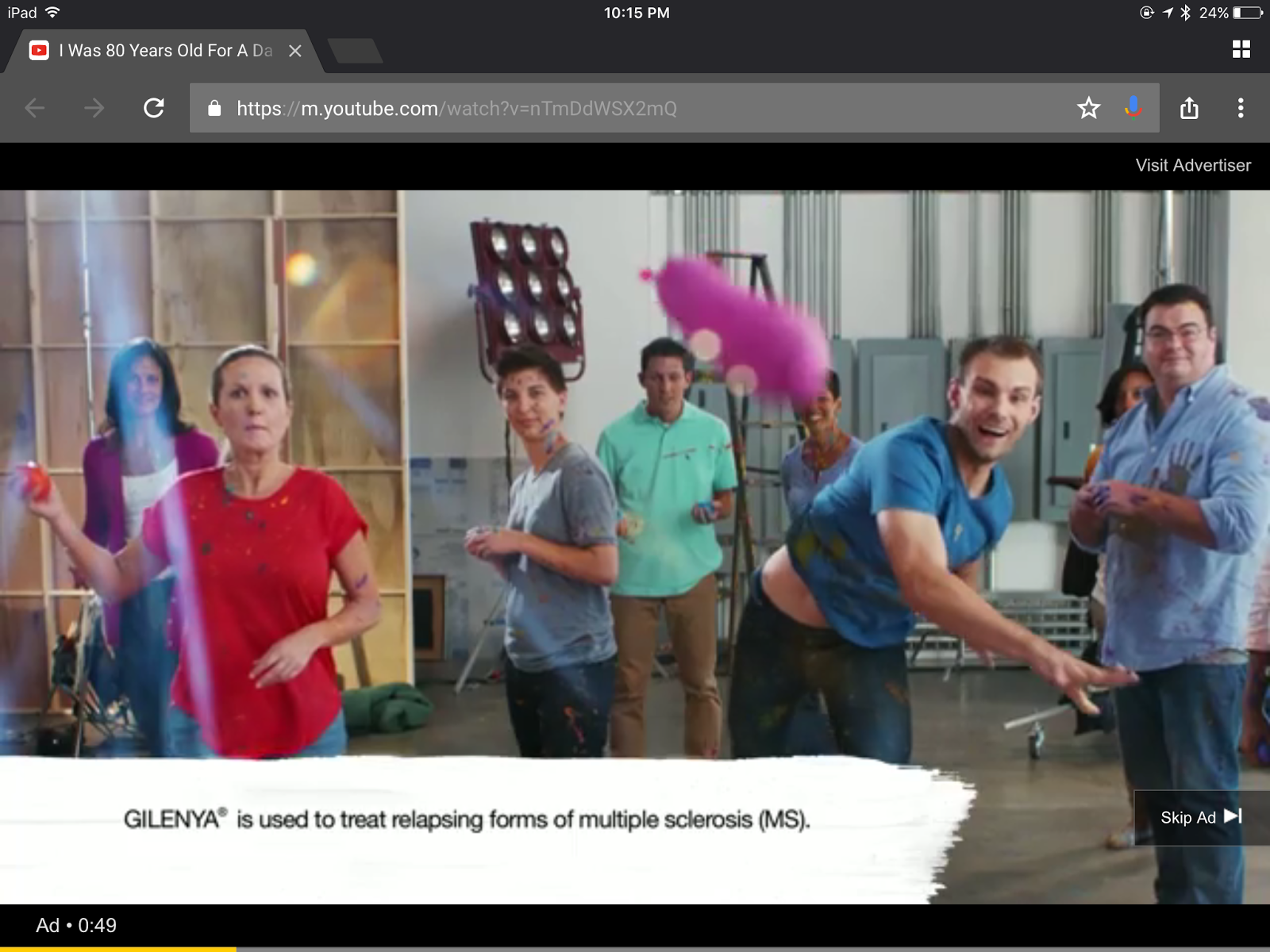
I was watching a Buzzfeed video (yes, I know I should not become addicted to these videos) and there was an ad playing about multiple sclerosis. I normally just try to skip the ad as fast as possible because I want to watch the video. However, after further thought, this action—adopted by almost everyone—is a signal of our rejection of viewing chronic illnesses. We are not interested in learning about a disease that many people around the world suffer. Yet, the commercials are also at fault. If you look below, the images show happy, active people who look perfectly “normal.” It is as if this magical medication was able to cure their illness and keep their nervous system intact. Not to mention, the last photo states, “real people, real stories.” If the ad is truly a demonstration of people who suffer from multiple sclerosis, why do none of people have a slight motor disability? Sure, a drug can slow down the progression of the disease and alleviate a few symptoms, but the people would still have some issues—including the side effects the lady on the picture seems happy about.


People who are initially diagnosed with this degenerative disease are told the same facts: there are no cures, there are only treatments to help alleviate symptoms, you will end up in a wheelchair, and you will live until your imminent death. Not only do these people come to the salient realization that their future will not be what they imagined, but they also have to deal with the physical and emotional abuse society throws towards them. Scathing remarks—cripple—are precariously used to describe people with disabilities, causing a feeling of inadequacy; they compare themselves and see only the ideal body types being displayed. While “normal” people may have surgery done to enhance their appearances, disabled people cannot escape it. They cannot hide from society and mask who they are: they are thrown into a society that neglects the need for accessible facilities. Take Troy High School for example. The hallways are far too crowded to give students on wheelchairs space to maneuver; the defunct elevator moves at a snail’s pace, almost suggesting that getting to the students’ destination in a timely manner is not important; the classrooms have tables that are too high to reach.

Furthermore, this daily struggle is not simply faced during their childhood—it is a continuous cycle that they must face. I recently watched What Would You Do? and how deaf discrimination pays a roll in job employment. The show set up a scenario where a manager openly said that he would not accept the deaf girl’s application. As with most episodes, there are always many Samaritans who object the injustice presented. However, only one man brought himself to go against the manager’s judgement, stating that rejecting an application based on a disability is outright discriminatory. Not to mention, there were several human resource workers who not only supported the manager’s decision, but also gave him advice on how to handle the situation better: accept the application but write a note reminding yourself that the applicant is “unfit.”

Our society is not just unaccustomed to seeing disabled people, but it believes that these people are not inherently equal to everyone else. As Mairs states, “for the disable person, these include self-degradation and a subtle kind of self-alienation not unlike that experience by other minorities” (14). Although many people with disabilities are able to come to terms with their body, many still struggle with internal hatred: the belief that they are not as valuable and are the rejects of society.

Even though I do not have a disability, I suffer from a chronic disease that I still have not completely come to terms with. Not even my closest friends know what I suffer through. Compared to people with a disability, I am given the luxury of hiding my secret from the world. I remember when I first showed symptoms and was diagnosed I always asked, “Why me?” From then on, I have always hidden it away from society. Although it is an extremely common illness, I still cannot find the strength to tell anyone the specifics except for my family. I worry that people’s image of me will transition from the diligent junior to the junior with the disease. It has irrevocably changed me mentally and physically. Even to this day I wonder what my life would be like without having to deal with it. I have experienced the searing glances people give that make you feel less of a person; I have seen the ads displaying the perfect people “suffering” from my disease. I have felt like certain things are inaccessible to me; I have felt the internal torment of badly wanting a new life. Despite my reservations about telling people, I have learned to appreciate who I am. That statement may sound paradoxical, but there is a difference between revealing something to the world and understanding who you are. In the future, I hope that I become as brave as people who suffer from disabilities—to not care about what other people think of me. 

Saturday, December 17, 2016

FOMO (Fear of Missing Out)

“No. Travis, you stay right here. And you make him understand what you doing, Walter Lee. You teach him good. Like Willy Harris taught you. You show where our five generations done come to” (Hansberry 147).

Family values transcend through each generation. Mama’s five generations believed in fighting for one’s family, trying to stay as a homogenous family unit. When Walter tries to sell the house to Mr. Lindner, he is metaphorically exchanging all the morals he has been taught for money. In effect, he will be empty inside, consumed by the societal ideal to achieve a higher socioeconomic status in life. However, Mama allows Travis to stay and “grin innocently” (Hansberry 147). Although Walter has already lost his innocence, he cannot take himself to destroy Travis’s innocence; he does not want Travis to see him trade his morals for money and see his black culture be subservient to the white race. As Travis looks up to Walter for guidance, Walter does not want him to feel trapped in a society filled with racial divisions. Instead, Walter’s decision acts as a model for Travis to stand up for his beliefs, fighting injustice and not giving in.

Loss of generational values is seen even in our 11 AP class. Our parents all went to school without advanced smartphones to text in class, snapchat, tweet, etc. Talking face-to-face and hanging out with friends is now being replaced with hours spent trying to take the perfect selfie or video to upload on one’s snap story. Despite regulations put in place to limit cellphone use, our generation has the audacity to continue using our phones constantly in class, having our eyes glued to our tiny screens. In a way, we have all adopted FOMO (Fear of Missing Out). This fear of regret—loss of social interaction—permeates through our minds; we adopt this obsession to know exactly what is going on in society at every moment. One ring from our phones makes everyone in class wonder if they received a notification, turning our attention to our phones. Now I am not saying that I am the perfect person. I waste copious amounts of time just refreshing Facebook to see if anyone posted something new. Snapchat almost trapped me into a cycle of destruction this summer: trying to maintain Snapchat streaks.

 
This is me trying to keep my Snapchat streaks

However, we must return to our past generation’s values; we must take the conscientious effort to ignore our phones when they get a new notification; we must limit our social media usage; we must concentrate what is in front of us; we must respect others. Travis reminds Walter of the 5 generations of family values just as Val should remind us of our past generation’s values. Is it worth it to check our phone or should we focus on our education? (however, I am left to wonder how students from last year got so many photos of Val for their memes)

Saturday, December 10, 2016

A Dream Deferred

It was 1998, just four years after my parents immigrated to the US; they were hoping to achieve that American Dream—a stable life having the ability to do what they wanted. I was not born until 2000, but my parents and two older sisters lived comfortably in Raleigh, North Carolina. It was at that time when my mom’s dream was deferred.


My mom tells me the story like it was yesterday. An old man was selling his gas station because he wanted to retire and move to Florida with his family. Finding out about this one in a lifetime opportunity, my mom instantly wanted to invest. The best part about the deal was that the owner did not even expect a down payment. He told her that “the profits you make minus your living expenses can be paid to me until you eventually pay it off.” This was the ultimate deal. Showing interest in leadership as a child, my mom saw this as the perfect opportunity to exercise her freedom that was not given to her in China. She would no longer have to be told by her teachers that women cannot take leadership positions. She would challenge the patriarchy that runs our society. She could enhance our family’s life in America and achieve her lifelong dream. 


Despite the perfect offer, my dad had reservations about this. What if we ended up losing money? What if we could never pay the man back? What if…? It posed too big of a risk, and my dad was not willing to take it. After experiencing the poverty that plagued China at that time, my dad could not imagine ending up on the streets of America, begging for money. He, on the other hand, wanted to make a stable income from his job and save money for our college tuitions gradually, avoiding any major risks as possible. With that, my mom’s dream was deferred.

My parents will never forget the 1960s.
Now, almost 19 years past, my mom’s dream is starting to “dry up like a raisin in the sun…[and] sag like a heavy load.” After that offer, my mom was never given another opportunity. Her main focus from then on was to give me and my sisters the best education possible—to provide for us what she was never able to achieve. I think this is what motivates me and my sisters. My mom could have easily spent the thousands of dollars our parents are spending on us to go to college. Not only are they willing to pay for our undergraduate education, but they are also willing to take loans out if we need them. My mom’s dream did not have to be deferred because my dad would not have to worry about providing for us. How could we possibly complain about how challenging our lives are when my mom gave up the only dream she had? How could we hate school when my mom’s dream was deferred to pay for it?

My mom’s altruism made her dream change into seeing us succeed in the future. However, deep down, I know that she still wants to start her own business. And one day when I receive my first paycheck, I will defer my dreams, like my mom did 19 years ago, so she can fulfill hers before I care about my own.

Someday I will return the sacrifices my parents made.
  

Sunday, December 4, 2016

Borne Back Ceaselessly Into the Past

“Gatsby believed in the green light, the orgastic future that year by year recedes before us. It eluded us then, but that’s no matter—tomorrow we will run faster, stretch out our arms farther. . . . And then one fine morning—

So we beat on, boats against the current, borne back ceaselessly into the past.” (180).

This passage concludes the novel in the most profound way. Gatsby is no longer the only one chasing an unachievable dream; instead, “we” all will try to run towards our goals. Our whole lives are built around trying to achieve meaning in society. Although many people try and ignore this fact, we will all eventually die. Everything that we have worked so hard to achieve will lead us to become another statistic; our lives will simply be noted on a death certificate; all of our memories will vanish to nonexistence. This almost reminds me of my AP Environmental project I did last week. We were counting the number of people who died within certain age groups, not even taking note of the person’s name. All those people on the list who probably wanted to reach something in life were turned only into one line on a page:
Name, Date of Birth, Date of Death.


Gatsby’s whole life was defined by his hope to recreate the past—to go back five years and marry Daisy. The more he worked to achieve his goal, the more it moved farther away from him. Using an ellipsis, Fitzgerald highlights the long, dragged out cycle in our lives, only to achieve nothing. This repetitive life that we choose to chase a dream that—in reality—is not even possible to achieve. The American Dream that is the epitome of America’s history is only to be an illusion. Something so well know, but so abstract.

This passage also reminded me of a poem by Langston Hughes:

What happens to a dream deferred?

      Does it dry up
      like a raisin in the sun?
      Or fester like a sore—
      And then run?
      Does it stink like rotten meat?
      Or crust and sugar over—
      like a syrupy sweet?

      Maybe it just sags
      like a heavy load.

      Or does it explode?

I would argue that Gatsby’s dream goes through the same process of decay that African American dreams go through, as described in the poem. Although Gatsby continues to believe that his dream is possible, it actually becomes the explosion that kills him. The “East…that distorted beyond my eyes’ power of correction” makes the American Dream impossible; the corruption and dirt infiltrates Gatsby’s dream. How can Gatsby’s dream be fulfilled in such an unyielding earth?

Another unachievable dream: Watching The Great Gatsby in class J


Saturday, November 26, 2016

My Epiphany this Week

I find it ironic that we started reading The Great Gatsby this week. It was as if Ms. Valentino was allowing us to immerse ourselves in the world’s obsession with material goods. The excessive spending that characterizes the 1920s parallels to the amount of money people spend during the Black Friday Weekend.


I felt like Nick Carraway as I watched people make extravagant purchases, putting them on credit. Similarly, Nick watched “men and girls [come] and [go] like moths among the whisperings and the champagne and the stars” (Fitzgerald 39). Everybody somehow ended up at Gatsby’s door” (Fitzgerald 41) just like how everyone ended up at some retail store last Thursday and Friday. The need to buy the latest gadgets that were on sale forced people to line up outside stores for hours, hoping to buy the 55-inch TV that was discounted $250. Although my parents and I did not originally plan to participate in this “tradition,” we still felt the need to see what was on sale—the need to buy something drew us in.

Materialism was at work, molding every person in the US to purchase something that would, in theory, make us happy.


We went to Best Buy at 6:00, not planning to get any of the “doorbusters.” As we walked around seeing what was on sale, my parents decided that they needed to buy a new TV to replace the one in their room. The new amazing features forced my parents to believe that it was a necessity. The discount was unavoidable, making it seem worth every penny spent. This one transaction turned into a night of visiting different retail stores to see what was on sale.

This is a perfect example of what people felt in the 1920s: every new item on sale was a necessity. People tricked themselves into the idea that their purchases would complete their life—as if they could not live without them. Inside, we are all similar to Daisy, crying at the sight of “such beautiful shirts…that [make] us sad because [we’ve] never seen such—such beautiful shirts before” (Fitzgerald 92).

Memories from APUSH

This need for material items has construed the meaning of Thanksgiving itself: to be thankful; instead, we forget who we are and spend ridiculous amounts of money. Thanksgiving was a celebration with the Native Americans who helped the Pilgrims survive; however, the pilgrims ended up killing them and taking their land. Our whole history is riddled with our conflicts with Native Americans because we are driven by the need for land. Even today we are invading reservations to build the Dakota Access Pipeline. It was on the news for a couple of days, and then we became focused on our own lives—we became focused on materialism.


NO DAKOTA ACCESS PIPELINE!

Whether Ms. Valentino purposely made us start reading The Great Gatsby on the Black Friday week or it was just a coincidence, I feel like we all begin to see the materialism that drives our country. Materialism not only damages our morals, but it also leads to devastating consequences: The Great Depression, The Great Recession, and who knows what else will come

Sunday, November 20, 2016

A Beautiful Ending


Last Friday we wrote an essay on The Bluest Eye, focusing on a single scene within the book. I felt like I did better on this essay compared to the MAUS essay. Looking back at it, I felt more connected with The Bluest Eye. I am not saying MAUS was a bad novel, but I could draw parallels between my life and Pecola’s (as seen from my past blog posts). However, my experiences are not as damaging as Pecola’s; I can never truly understand Pecola’s life because of her extreme suffering. At the end of the novel, she becomes trapped in a schizophrenic state, believing that everyone is jealous “ever since [she] got [her] blue eyes” (Morrison 195). 

Pecola’s destruction stems from her disconnect with society; she cannot find a community that can relate with her experiences. Even though Claudia and Frieda are friends with Pecola, they are still ignorant of the pain she suffers though, learning the dirty truth in society by watching Pecola’s experiences. Without someone to help her cope through her tough life, Pecola goes down a spiral of self-loathing, hoping for blue eyes to fix her problem.

Furthermore, I loved the way that Morrison ended the novel. Combining a metaphor with insightful statements, Morrison is able to clearly elucidate the damaging effects of racism, incest, etc. The bird that was “winged but grounded…intent on the blue” (Morrison 204) is Pecola; the blue eyes are higher than her, surrounding her just like the blue sky. The blue eyes are there to remind her of her insignificance because she is unable to attain them.

Morrison also presents one final argument that differs from society. She says that “love is never any better than the lover,” (Morrison 206) contrasting with the thought that love is always positive. Cholly may have “loved her” (Morrison 206), but Pecola was destroyed by it. Cholly has never felt real love or had a normal childhood. Any love that Cholly gives to Pecola will make her “shorn, neutralized, frozen in the glare of the lover’s inward eye” (Morrison 206).


Finally, alluding back to the metaphor of the earth, Morrison demonstrates how the damage on Pecola is total. However, by ending the novel with a qualifying phrase, “at least on the edge of my town,” Morrison displays a sign of hope within society. Pecola’s life may be a reminder for the damage that can be done, but with a communal effort, we can fix the issues that plague our society.


Sunday, November 13, 2016

The Bluest Election

Dear readers,


I am sorry I did not post earlier. I usually try and have my post done on Saturday, but I had many activities this weekend. This week's post may go against your views, so it is okay if you do not agree. 

Morrison utilizes the seasons throughout her novel to emphasize the cycle that Pecola goes through—the cycle of abuse. Through each chapter, Morrison juxtaposes the season's normal connotation with an unfitting event to highlight the disorder in Pecola's life. (Maureen Peal, a idolized, vivacious girl, juxtaposes the normal, gloomy days defined by winter, Pecola's rape scene juxtaposes the bright days defined by spring, etc.). However, this week does not need to be juxtaposed to emphasize disorder. The election of Donald Trump was devastating to me. I felt like the falling leaves that characterizes fall; the fate of this country in the upcoming months will wither away. While some leaves (people) remain on the coniferous trees, other people (leaves) will fall and disintegrate. The cold dark days that loom ahead of us are another reminder of the time left we have with complete freedom. Soon, we will be trapped by the wall, shutting ourselves from the cultural diversity that originally defined this country. 

The results of the election "yanked [me] up by the arm, slapped [me] again, and in a voice thin with anger, abused [me] directly" (Morrison 109). Originally, I joked with my teachers and friends at the thought of Trump winning—it was impossible; even Mr. Aldinger said there was little change of it occurring. Pushing me out my ignorance, the election results revealed the truth behind Mr. Trump's words. I was no longer shadowed by lies, and I now had to deal with a President who said "when Mexico sends its people, they’re not sending the best. They’re not sending you, they’re sending people that have lots of problems and they’re bringing those problems with us. They’re bringing drugs. They’re bring crime. They’re rapists… And some, I assume, are good people" and that "the concept of global warming was created by and for the Chinese in order to make U.S. manufacturing non-competitive."


Pecola's innocence was destroyed when Mrs. Breedlove abused her; instead of protecting her own daughter, she decided to shield a little white girl from the truth. Mrs. Breedlove refuses to tell the "little pink-and-yellow girl" what is happening by saying "don't worry none, baby" and "'course I will" (Morrison 109). By showing love towards a white girl, Pecola begins to realize the world is not made of perfect families, which are normally portrayed in movies; instead, there are parents like Mrs. Breedlove who are disillusioned with society themselves and vent their anger on their children. Morrison further demonstrates a fall of innocence by alluding to the fall of man. Mrs. Breedlove spits "rotten pieces of apple" (Morrison 109) at Pecola, elucidating the harsh reality that Pecola is only now beginning to realize. This "rotten" (Morrison 109) truth that Pecola discovers is not even completely revealed to her; through the rest of the novel, Pecola will begin to piece together the "pieces" (Morrison 109) that are slowly, internally destroying her.

Similarly, my understanding of the world is only slightly beginning to be revealed. Is it fair that Hillary Clinton won the popular votes but Donald Trump wins the election? Is it fair that most of Donald Trump's votes came from uneducated rural populations, leading to his victory? I used to think of the government as an imperfect solution that is the best we have; now I am realizing the corrupt nature of politics. Our world is defined by profit and loss, winner and loser, power and helplessness, etc. While the election results may shadow the words that Donald Trump said to others, my innocence is destroyed. Soon, the "little girl in pink" (Morrison 109) will realize what he/she has done.

Repost from the Facebook Group